Celebrating One of Our Nation’s Greatest Achievements
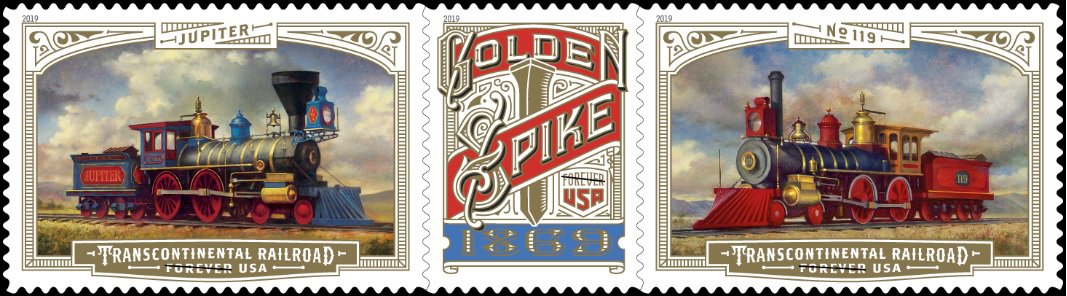
As we celebrate the United States' 250th birthday this week, one major achievement stands out in the history of our country - connecting both coasts with a web of iron and steel. Spanning the continent by rail contributed greatly to the American experiment and a young nation's aspirations.
Declaring our independence in 1776 and establishing a democratic republic set the U.S. on a course of greatness in the world. Yet, the sheer vastness of the land required more than governance and strong wills. A new nation, 3,000 miles across, bounded by two oceans with formidable geography in between, was far from conquered.
Early travel across the continent was usually by horse & wagon, and sometimes by foot. It was slow, arduous, and potentially deadly. A new mode of transportation was needed, one that harnessed the growing Industrial Revolution - an iron road connecting the burgeoning new nation. In 1825, the two main drivers of the Industrial Revolution, iron and steam, came together to create this mode of transportation. That year saw the first “rail road” debut in Great Britain.
By 1827, this technology was embraced by the new world an ocean away. England's invention to increase speed and convenience of travel had a third advantage in the U.S. - that of conquering distance. Our country quickly saw the railroad's potential of spanning vast spaces - until then a formidable challenge to its sustainability as a separate nation. To quote noted rail historian and preservationist John Hankey, it was, "...the final act of independence."
And while 1827 is considered the birth year of railroads in the U.S., their development was limited to the eastern states where manufacturing and geography were conducive to development. Construction of railroads across the entire continent was considered fanciful at best. But rail lines spread like roots between the Atlantic and the Mississippi River, along with improvements in the trains themselves.
By the1860s, our nation was in the grips of civil war, but determined to push rails westward. Finally, the first railroad to the Pacific was completed in 1869, a historic achievement as the nation recovered from war. Built by the Union Pacific and Central Pacific railroads, the line transformed our nation's growth trajectory. The lines’ completion at a mid-point in Utah was announced instantly with a one-word telegraph message, "Done." Along with the rail line came new settlements, commerce, and later, tourism destinations. Other transcontinental lines followed, traversing along more southerly and northern routes.
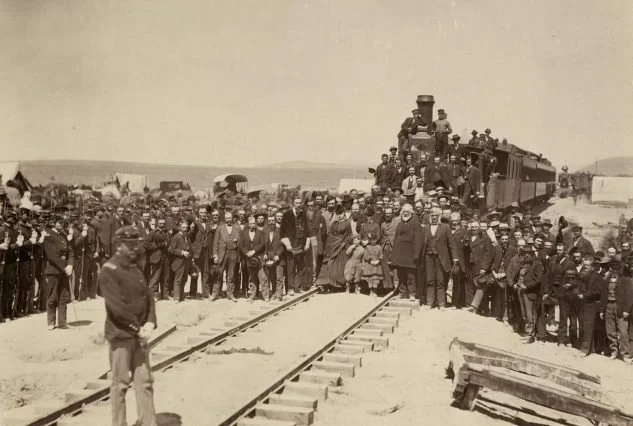
The first transcontinental line served as the Nation’s backbone. It was a prime mover during economic booms and world wars, as well as fostering the migration of whole populations. Tracks and bridges were improved along the original route, with larger and faster trains appearing in subsequent years. At the same time, steam technology evolved, giving rise to ultra powerful locomotives that dwarfed their predecessors.
The mid-twentieth century saw the transcontinental line put to the ultimate test. Trains of troops and essential materials travelled coast to coast during World War II. The railroads rose to the logistical challenge of supplying two theaters of war across three continents.
The war years were considered steam's finest hour, with some of the largest locomotives ever produced built for the effort. But a new form of motive power was gaining favor as the railroads pressed everything they had into service. Diesel-electric locomotives were proving their worth alongside steam. By the end of the war, steam's days were numbered as internal combustion's low operating costs became evident. During the post-war years, established builders like Baldwin and Alco were seeing new locomotive orders go to relative newcomers like General Motors and later, General Electric. By the 1960s, diesels had fully supplanted steam, with high horsepower designs equaling the tractive efforts of their powerful predecessors.
The Museum of the American Railroad features the ultimate examples of both steam and diesel motive power. These locomotives span over four decades of service over the original transcontinental route. Both gifts of the Union Pacific Railroad, they now sit majestically side by side for the education and enjoyment of a new generation.
Two Iconic American Locomotives on Display in Frisco, Texas
Big Boy - A True Giant of the Rails
Union Pacific #4018 is one of the most powerful steam locomotives in the world. Its concept and design were brought to fruition by the need to haul heavier trains over the Continental Divide, and impending world war in the late 1930s and early 1940s.
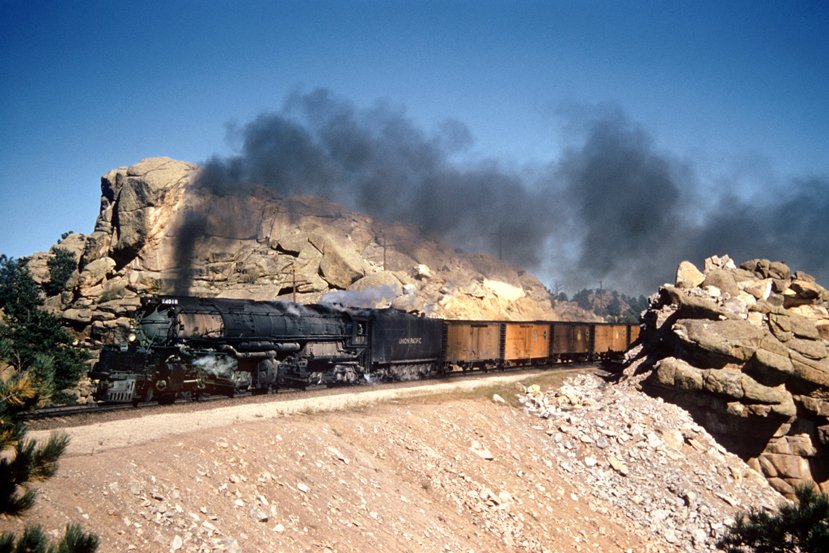
In this view above by Jim Ehrenberger, #4018 is seen traversing Sherman Hill ca. 1957.
Dubbed Big Boy, it was classified as a simple articulated locomotive, essentially two engines under one frame with a common boiler. Weighing in at 1.2 million pounds, it operated between Ogden, Utah and Green River, Wyoming, and later between Cheyenne and Laramie, Wyoming. Built by the American Locomotive Company of Schenectady, New York in 1942, #4018 is considered the best blend of power and speed among the largest steam locomotives. Big Boys displayed a spectacular show of smoke and steam under load hauling up to 120 cars at speeds of 60 MPH.
Big Boy #4018 made its last run in 1957 and was stored serviceable in Green River, Wyoming pending a surge in traffic. That surge never came, and it was officially retired in 1962. Donated to the museum in 1964, it became the centerpiece of the original "Age of Steam Exhibit" at Fair Park in Dallas. It is one of eight preserved Big Boys from the original fleet of 25 built. Another preserved example, #4014, was restored to operation by Union Pacific. It makes annual tours of the system when not stored in UP's steam facility and roundhouse in Cheyenne, Wyoming.
Centennial - Big Boy’s Younger Brother
By the 1960s, steam had given way to diesel-electric technology. But multiples of these locomotives were required to equal the pulling force of just one of the largest steamers. Union Pacific's quest to rival big steam on a single-unit diesel finally came in 1969.
Coinciding with the 100th anniversary of the first transcontinental railroad, General Motor's Electro-Motive-Division introduced the Centennial. Custom built for Union Pacific, these 99-foot-long behemoths came within a few horsepower of their big articulated ancestors. A total of 47 model DDA40X Centennial locomotives were built. They were essentially off the shelf components of two locomotives mounted on one frame.
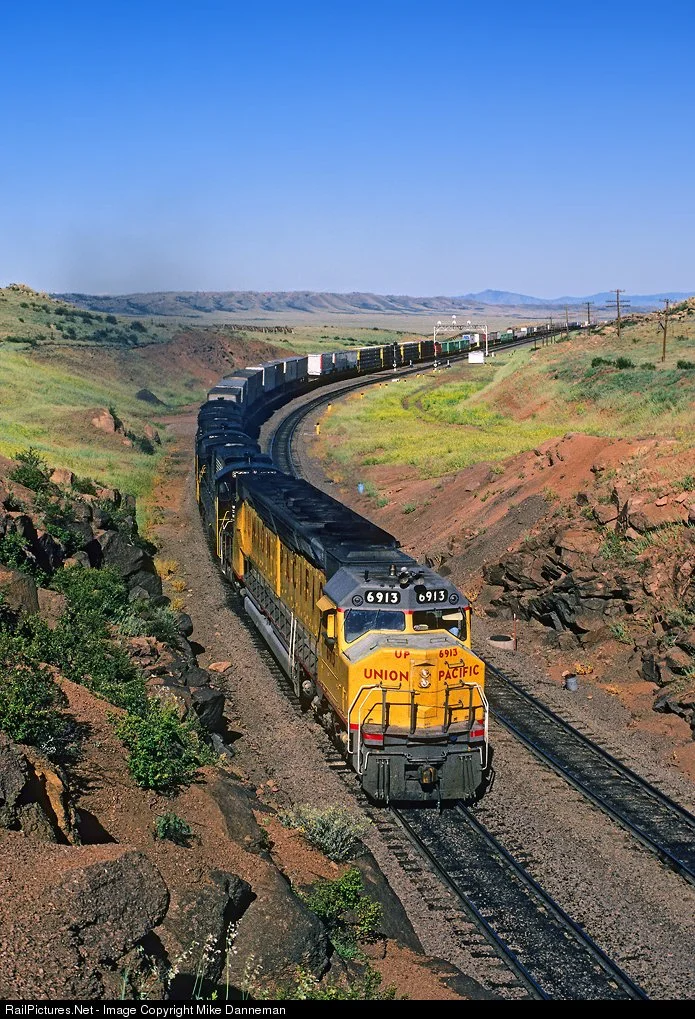
The image above shows Centennial #6913 in service on Union Pacific's transcontinental main line near Hermosa, Wyoming. This dramatic photo was taken by Mike Danneman in July of 1984. Here, #6913 leads an eastbound intermodal freight over 8,250 ft. Sherman Hill.
While successful in design, these locomotives had a relatively short service life of 17 years due to higher maintenance costs and the advantages of multiple-unit diesels. Centennial #6913 was retired in 1986. It is one of 13 preserved examples. It now sits proudly alongside Big Boy #4018, firmly holding its title as one of the superlatives in motive power.
The Museum of the American Railroad is the only venue to display these historic locomotives side by side, representing nearly 50 years of high tractive effort, high horsepower railroading!
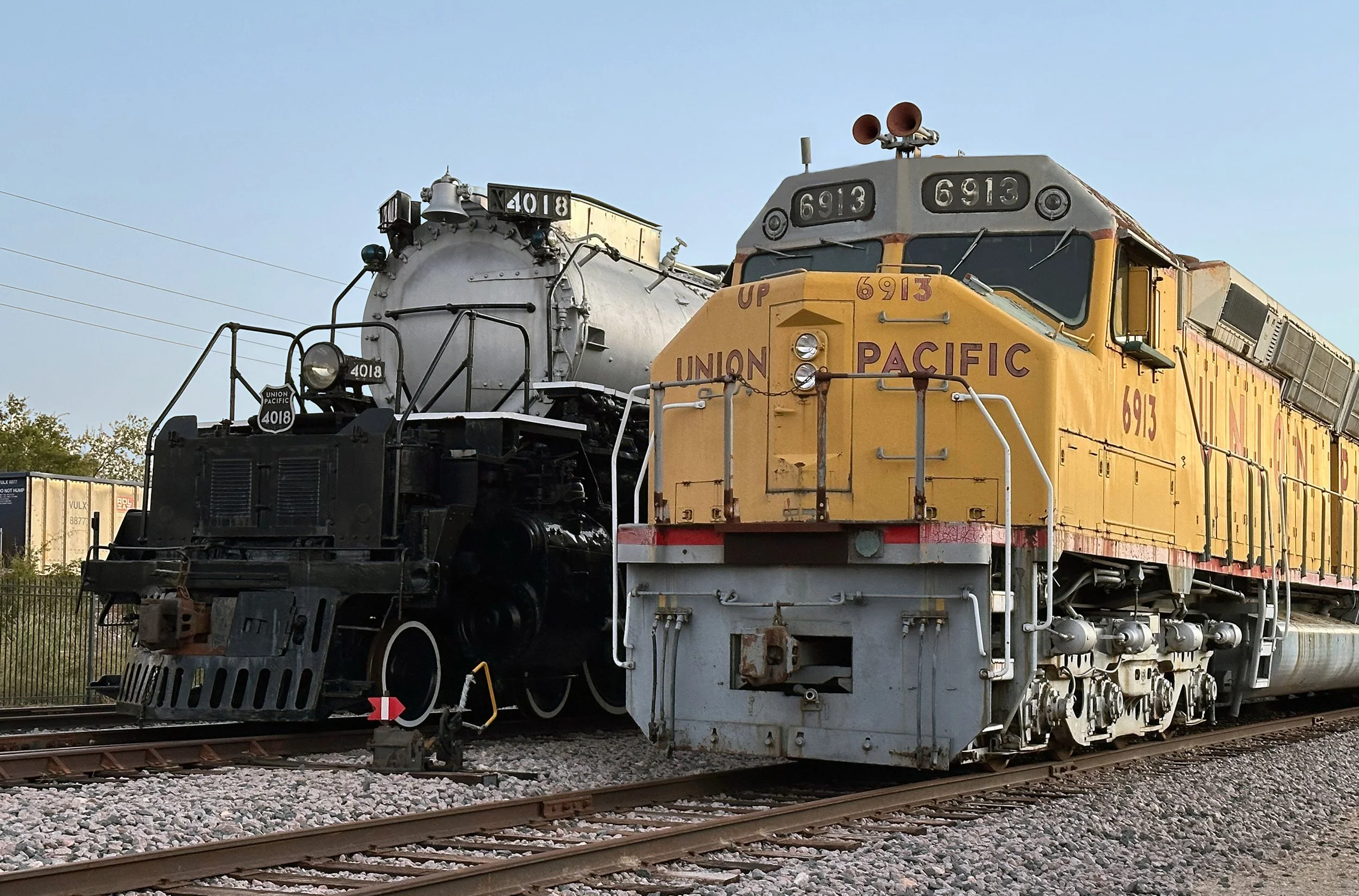
This year, the Museum of the American Railroad proudly celebrates our nation’s 250th birthday. And next year, we’ll recognize 200 years of railroading in the U.S. Look for more exciting and informative programs & exhibits as we commemorate two important anniversaries!
New Friends of MAR Memberships Available
Join the Friends of the Museum of the American Railroad to support our efforts and get some great perks!
Family and Individual levels are available, so there's something for everyone!
Participate — Museum of the American Railroad
Thomas the Tank Engine is Heading back to Texas!
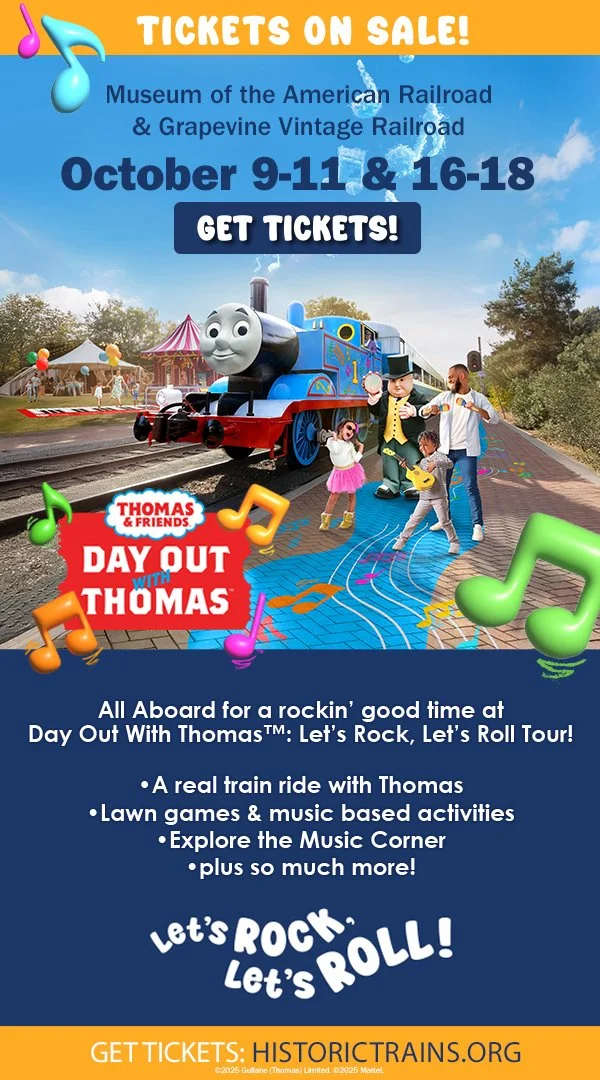
Day Out with Thomas is on the calendar to return to North Texas in October!
An annual fundraiser for the Museum, Day Out with Thomas is an ideal way to spend time with your family, enjoy live entertainment & a train ride, and support the Museum and its efforts all at the same time.
We are grateful for your attendance and look forward to seeing many familiar faces and new attendees for the 2026 event.
A partnership between the Museum of the American Railroad and the Grapevine Vintage Railroad, proceeds help fund educational programming and rail preservation at the Museum.
This year's theme is "Let's Rock, Let's Roll" so arrive ready to rock & roll with Thomas and his friends in historic downtown Grapevine, Texas.
More information & tickets available here: Events — Museum of the American Railroad
Don't miss your chance to rock & roll with Thomas October 9-11 & 16-18! Use promo code EARLYBIRD26 for $4 off each ticket when you purchase in the month of July.